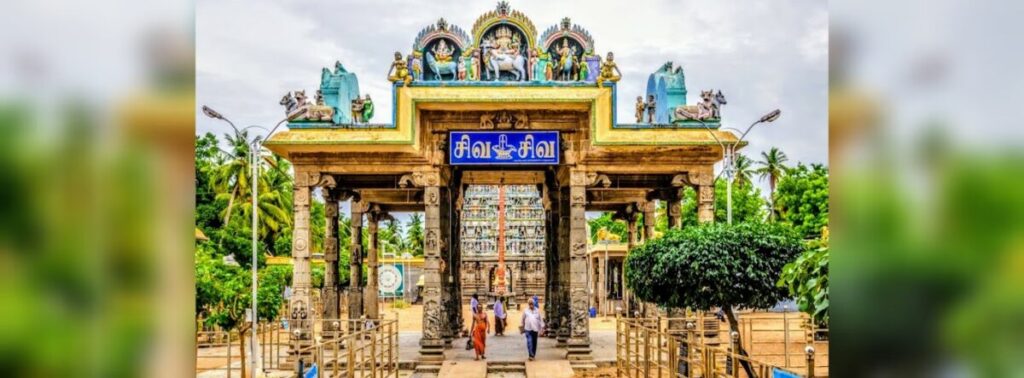
Thiru Nangur
HIGHLIGHTS:
- Eleven Vainava Divya Desangal
- Twelve Shiva Temples (two Devara Paadal Petra Sthalangal)
- Pancha Narasimha Kshetrangal
- Eleven Garuda Sevai Festival
- Twelve Rishabha Sevai Festival
Thiru Nangur is located in Nagapattinam District, near the town of Sirkazhi. It houses eleven of the 108 Vainava Divya Desangal.
All the eleven of them were done Mangalasasanam by Thirumangai Azhwar, who was born and lived in this region. His life story is closely linked to Thiru Nangur.
ETYMOLOGY:
Thiru Nangur might have got its name from the fact that it is a conglomeration of four villages. (Nangur = Naangu + Oor)
EPITHETS:
- Maraiyor Vananga Pugazh Nangur
- Manam Malgum Nangur
- Mangayar Mugam Kaatidum Nangur
- Kayal Odi Vilayadu Nangur
- Settralayil Ven Mutham Sindhum Nangur
- Kali Muralum Nangur
- Theengani Nugarum Nangur
- Mannu Pugazh Nangur
- Nindru Arulum Idam Ezhil Naangai
- Pural Tharan Seidha Naangai
- Thvala Maada Needu Naangai
HISTORICAL FACTS:
- In the days of ancient glory, the border of Thiru Nangur had extended up to Poompuhar.
- Equivalent to Varanasi in fame
- Bodyguards to the Tanjore Brihadeeshwara temple were despatched from Thiru Nangur
- Sendhanaar, the clerk of Pattinathar, was from Thiru Nangur
- Pattinapaalai and Porunaraatru Padai are the literary works that mention the grandeur of Thiru Nangur
FESTIVALS:
- The Eleven Garuda Sevai festival
- The Twelve Rishabha Sevai festival
- Kali Katti Utsavam
THE ELEVEN GARUDA SEVAI:
The elven Garuda Sevai is a festival that happens annually, during the Thai Amavaasai. All the eleven Utsava Moorthies of the eleven Thiru Nangur Vainava Divya Desangal are brought to The Thiru Mani Maada Koil (32/108) and are taken as a procession on Garuda Vahanam, after being sung the Mangalasasanam by Thirumangai Azhwar. Then Manavaala Maa Munigal sings Mangalasasanam for Thirumangai Azhwar.
Thirumangai Azhwar from Thiru Nagari (34/108) is taken to all the eleven temples where he sings for The Deities there and then all the eleven Utsava Moorthies are led by Thirumangai Azhwar and his wife, Kumudhavalli Natchiyaar on Hamsa Vahanam and Manavaala Maa Munigal on Sesha Peedam.
The next day, Thirumangai Azhwar returns to Thiru Nagari and does Mangalasasanam for both Thiruvaali and Thiru Nagari (35/108), which are together considered as a single Divya Desam.
THE TWELVE RISHABHA SEVAI:
The twelve Rishabha Sevai festival happens annually in Thiru Nangur during the month of Vaigasi during the Rohini Nakshathram. Due to unforeseen circumstances, this festival was abandoned for the past 100 years. The tradition has been renewed and the twelve Rishabha Sevai is happening since the year 2016.
Mathanga Maharishi was born out of the Matangam, the elephantine form which Brahma Dev took to meditate on Lord Shiva. He undertook severe austerities seeking The Lord’s blessings.
Devi Parvathy was born as a baby in the pond and was raised by Matanga Maharishi as his own daughter. He named Her as Matangi. Lord Shiva came as Matangeshwarar and married Raja Matangi and showed His “Kalyana Kolam” to Matanga Maharishi.
This temple is situated near the Thiru Mani Maada Koil (32/108).
There are 11 more temples of Lord Shiva in Thiru Nangur. And during this festival, all of them arrive here and are taken as a procession along with their consorts on their bull mounts.
THE LORE OF THIRU NANGUR:
The story takes us back to the time of creation. Shiva is Mahadeva. His Shakthi, His half, His Devi is Prakriti. The personification of creation itself. Being the essence of energy itself, She had to get detached from Shiva for the benefit of the cosmos to pervade in each and every atom. Thus, Shiva became a hermit, an ascetic. A Vairagi, who had renounced all worldly pleasure and abhorred companionship.
But the union of Shiva/Shakthi was inevitable. The essence of Aadhishakti was drawn to Her Shiva. So, she decided to attain Him. She was born as the eldest daughter to Daksha Prajapati who named Her as Sati. She was always daddy’s-little-princess and hence also revered as Dakshayani (She who follows Daksh)
Daksha was the son of Brahma Dev. He was the Prajapati who laid down the rules and norms of living a dutiful and productive life for all human beings. He had two wives, Prasuthi and Veerini. Together they had 62 daughters, of which Sati was the eldest.
As the days passed, Sati was drawn to the pull of Shiva and fell in love with Him. Daksha who was a staunch devotee of Mahavishnu, strongly disapproved of the love Sati had for Shiva. He was under the impression that a nomad, a crematorium inhabitant, a serpentine lover, an ash smeared aloof abomination like Shiva didn’t deserve his respect.
His hatred also stemmed from the fact that Shiva in his first act of valour, had beheaded one of the five heads of Brahma, Daksha’s father, in Thirukandiyur.
He arranged a swayamvara for Sati. He had invited all eligible suitors except Shiva. When the learned elders questioned this, Daksha made a statue of Shiva and kept it in the palace courtyard. Sati instinctively garlanded the statue and to her delight, Shiva materialised out of the statue and whisked her away to Kailash.
Daksha was so enraged that he renounced his daughter and ordered her funeral rites to be done. He was in no mood to accept Her. But Shiva and Sati were in their own blissful bubble. But the wheels of fate turned slowly, and trouble brewed.
Brahma Dev had arranged for a Maha yaagam and had called everyone to attend it. Shiva and Sati were specially honoured as they were the Divine Couple of the hour. Daksha came late to the altar and everyone rose to greet him obeisance. Shiva dint rise as He was present there as Mahadeva, The presiding God of the Yaagam and not as Daksha’s son-in-law. This infuriated Daksha a lot and he vowed to take revenge.
Daksha too organised a Maha yaagam, for the welfare of the world, just like Brahma did. He invited everyone, high and low. But he deliberately didn’t send an invite to Shiva ad Sati. When Sati came to know of this, she felt heart broken. She was upset two-fold because Her dearest father still hated Her, and Her husband was being insulted by being deliberately uninvited.
She decided to go to the Maha yaagam and convince her father to invite Shiva and to make amends to their broken relationship. Shiva refused to let Her go. He cited that it is never polite to go anywhere without being invited. Sati is in no mood to listen. She is adamant that She will go.
Shiva tried to reason with Her. He tells Her that she was no ordinary human princess and that She is Prakriti, Aadhi Shakthi Herself. And that she had to realise that and waken Her aura. He promised to accompany Her to the Maha yaagam if She did that. Shiva also told that if Sati doesn’t go to the Maha yaagam as Aadhi Shakthi, then a great calamity will befall on Her.
Sati could not bear this any longer. In a fit of rage, She shrieked at Him and said that if any harm would befall on a daughter who went to her father’s home, then let it happen. She also bound Shiva with Her words and said that He could come only after the impeding Catastrophe He predicted had happened.
Shiva sent Nandi and his entourage of Shiva-ganas as protection and went into meditation fearing the consequences of Sati’s action for Her own sake.
Sati reached the venue of the Maha Yaagam and called out to Her Father who insults Her for coming without an invitation. She tried to reason with Him and pacify Him, but to no avail. Her efforts as Dakshayani failed to rationalise with Daksha. Sati, as the wife of Shiva, tried to demand respect for her husband.
Daksha seized the opportunity and continuously flung a flurry of poisoned words at hapless Sati and hurled abuses on Her about Shiva. Sati begged him to stop. But Daksha, in his arrogance continued to speak humiliatingly about Shiva in derogatory terms.
Out of despair, Sati reached out to the elders at the altar and questions them on their silence to the injustice meted out by Daksha and his vile words against Shiva. All she received was a meek silence in reply.
An enraged Sati erupted as Aadhi Shakthi and in Her Viswaroopa, She told Daksha that She is Prakriti Herself and was born as Her daughter with the sole intention of Marrying Shiva. But in his arrogance, Daksha had insulted Her and Her husband. She felt saddened because She came blindly ignoring all the warnings of Shiva only to hear the derogatory words by Daksha.
She then decided that She is unfit to be Shiva’s wife as Dakshayani. She summoned Her own Yoga Agni and self-immolates Herself. Before incinerating Her mortal body, She warned Daksha about the consequences of his dastardly deeds. As Shiva has lost His wife, Daksha and the whole world will have to suffer. With that, the essence of Aadhi Shakthi again returns to Prakriti (Nature) and the cindered charred body of Sati falls into the altar in a conflagrated heap.
Nandi and the Shiv-ganas rushed to Shiva to tell Him of the diabolical vindictiveness of Daksha and the untimely demise of Sati. Shiva wakes up from his meditative trance and performs the pralaya Thandava. He is so enraged that the entire cosmos feels the ripples of His anger. He then unwinds his matted locks and tears a tuft of hair and creates a fierce eight-armed Avatar of Himself, Veera Bhadra. From another tuft of hair, He creates the fierce and gruesome to behold Bhadrakali. Shiva then tells them to go and decimate the Maha yaagam of fool-hardy Daksha and to kill him.
Veerabhadrar and Bhadrakali arrive at the altar and weave a storm of destruction raining blows to everyone who stood still during Daksha’s Shiva nindhanai and Sati’s self-immolation. A covering Daksha tried to escape but is caught by Veer Bhadra who trampled him beneath his feet, snatched all the beneficial boons bestowed on Daksha. In a single slice, He then proceeds to behead Daksha and flings the head into the same sacrificial altar that Sati chose to burn Herself. The Shiva-ganas and their leaders Veera Bhadrar and Bhadrakali returned victoriously to Mount Kailash after avenging the death of Devi Sati.
A heart-broken Shiva came to the altar and weeps for the loss of His wife, Sati. The whole world wept with Him. He carried the charred body of Sati and roams around the world in a gloomy misery. He forgot that He is Mahadeva. He aimlessly wandered the cosmos with the ashen burnt body of Sati.
Mahavishnu decided that the only way to make Shiva come to His senses was by releasing the remains of Sati from Him. So, Mahavishnu flings his discus at the body of Sati which gets cut into 51 pieces. The pieces (pindam) fall on 51 places all over the land. Being the essence of Sakthi, they get consecrated at places of Devi worship and are venerated as Shakthi Peedangal today.
Shiva was distraught with anger at the loss of his wife and started to dance. The cosmic dance of fury happened at Thiru Nangur. As the rage of the dance increased, hair from Shiva’s locks started to fall on the ground.
Wherever his hair fell, it became a Rudra and started to dance. This happened for elven times. Thus, eleven Rudras were created from the Hair of Shiva. All the eleven Rudras started to dance in fury. The entire universe trembled at their fury. Lord Vishnu decided to intervene and appeared in front of Shiva to pacify Him. On seeing Lord Vishnu, Shiva’s anger fizzled off and his fury relented. Likewise, Lord Vishnu took a total of eleven forms and stood in front of all the eleven Rudras to pacify them. And that is how the eleven Divya Desams of Thiru Nangur came into existence
THE ELEVEN DIVYA DESAM OF THIRU NANGUR:
|
Temple |
Divya Desam |
Lord |
Consort |
|
Thiru Kaavalam Paadi |
27/108 |
Gopala Krishnan |
Rukmini/ Sathyabama |
|
Thiru Arimeya Vinnagaram |
29/108 |
Kudamaadu Koothan |
Amruthakda Valli |
|
Thiru Vann Purshotthamam |
30/108 |
Purushothaman |
Purushothama Nayaki |
|
Thiru Sem Pon Sei Koil |
31/108 |
Sem Pon Arangan |
Alli Maa Malaraal |
|
Thiru Mani Maada Koil |
32/108 |
Badri Narayana Perumal |
Pundareeka Valli |
|
Vaigunda Vinnagaram |
33/108 |
Vaigunda Perumal |
Vaigunda Valli |
|
Thiru Mani Koodam |
34/108 |
Varadharaja Perumal |
Thiru Maa Magal Naatchiyaar |
|
Thiru Devanaar Thogai |
36/108 |
Madhava Perumal |
Madhava Nayaki |
|
Thiru Thetri Ambalam |
37/108 |
Palli Konda Perumal |
Sengamala Valli |
|
Thiru Vella Kulam |
39/108 |
Annan Perumal |
Alar Mel Mangai |
|
Thiru Paarthan Palli |
40/108 |
Thaamarayaal Kelvan |
Thamarai Naayaki |
THE TWELVE SHIVA TEMPLES OF THIRU NANGUR:
|
Temple |
Peedam |
Lord |
Consort |
|
Thiru Nangur |
Thathpurusha Peedam |
Mathangeshwarar |
Raja Mathangi |
|
Keezhai Thiru Kaatupalli |
Agora Peedam |
Aaranya Sundareshwarar |
Akilandeshwari |
|
Keezh Sattanadhapuram – Thiru Yogeeswaram |
Vaama Deva Peedam |
Yoga Naadhar |
Yogambaal |
|
Kaathiruppu |
Sathyjatha Peedam |
Sornapureeshwarar |
Sornambigai |
|
Thiru Nangur |
Soma Peedam |
Amrudhapureeshwarar |
Chandrakshi |
|
Alli Vilaagam |
Saarva Peedam |
Naaga Naadha Swamy |
Nattrunai Nayaki |
|
Thiru Nangur |
Mahadeva Peedam |
Nambuvaarku Anbar |
Anbirpiriyaal |
|
Thiru Nangur |
Bheema Peedam |
Kailasa Naadhar |
Kamakshi |
|
Thiru Nangur |
Bhava Peedam |
Sundershwarar |
Soundara Nayaki |
|
Perunthottam – Atheeswaram |
Praana Peedam |
Airavatheshwarar |
Athulya Gujaambal |
|
Annapan Pettai |
Rudra Peedam |
Sundershwarar |
Sundaraambaal |
|
Mel Nangur |
Paasupadha Peedam |
Nayana Varadeshwarar |
Nalinambigai |
THE PANCHA NARASIMHA KSHETRAM:
There are five Narasimha Temples in the vicinity of Thiru Nangur, which were worshipped by Thirumangai Azhwar.
|
Temple |
Deity |
|
Thiru Kurayalur |
Ugra Narasimhar |
|
Mangai Madam |
Veera Narasimhar |
|
Thiru Nagari |
Yoga Narasimhar |
|
Thiru Nagari |
Hiranya Narasimhar |
|
Thiruvaali |
Lakshmi Narasimhar |
EKADASHA RUDRA – THE ELEVEN FORMS OF LORD SHIVA ACROSS LITERATURE:
|
Number |
Matsya Purana |
Vishnu Purana |
Mahabharata |
As Sons of Tvastsr |
|
1 |
Nirriti |
Manyu |
Mrgavedha |
Vishva Rupa |
|
2 |
Shambu |
Manu |
SArpa |
Ajaikapadh |
|
3 |
Aparajitha |
Mahamasa |
Niritti |
Ahi Budhnya |
|
4 |
Mriga Vyadha |
Mahan |
Ajaikapadh |
Virpaksha |
|
5 |
Kapardhi |
Siva |
Ahi |
Raivata |
|
6 |
Dahana |
Rtudjwaja |
Budhnya |
Hara |
|
7 |
Khara |
Ugraretas |
Pinakin |
Bahurupa |
|
8 |
Ahir Abradhya |
Bhava |
Dahana |
Tryambhaka |
|
9 |
Kapali |
Kama |
Ishvara |
Savitra |
|
10 |
Pingala |
Vamadeva |
Kapali |
Jayanta |
|
11 |
Senaani |
Dhrtavarta |
Sthanu |
Pinakin |
OUR EXPERIENCE:
We decided to postpone the written updates of the other temples and jump to Thiru Nangur because we had been there recently for the eleven Garuda Sevai and were overwhelmed by the splendid and amazing festival.
The post above will give you an idea about Thiru Nangur. We will be covering the 11 Vainava Divya Desams, 2 Devara Paadal Petra Shiva Sthalangal and the 5 Pancha Narasimha Kshetrangal in the days to come.
Thiru Nangur needs a solid week to cover all the temples in the are at leisure. And the two major festivals that happen annually are a must-see event. We are looking forward to the twelve Rishabha Sevai festival in May and will update about it when it happens.
We will be writing our accounts of the eleven Vainava Divya Desangal and also Thiruvaali/Thiru Nagari (35/108), which is very close to Thiru Nangur and then follow them up with a pose on the eleven Garuda Sevai festival that happened this year.
Thirumangai Azhwar has a very intimate connection with Thiru Nangur. He was a vigilante, an anti-hero, a Robin Hood of sorts and the events that transpired here led him to become the most prolific composer of Paasruams and the most travelled Azhwar among the twelve. We will be writing a separate post dedicated to him as his story cannot be condensed and written along with anything else.
Daunting tasks ahead, but we are SO looking forward to it. Stay tuned for more interesting updates. See you folks at the beginning of an amazing journey of scribing our pilgrimage – Thiru Paarthan Palli (40/108)
Loads of Love,
Karthick and Rahul.