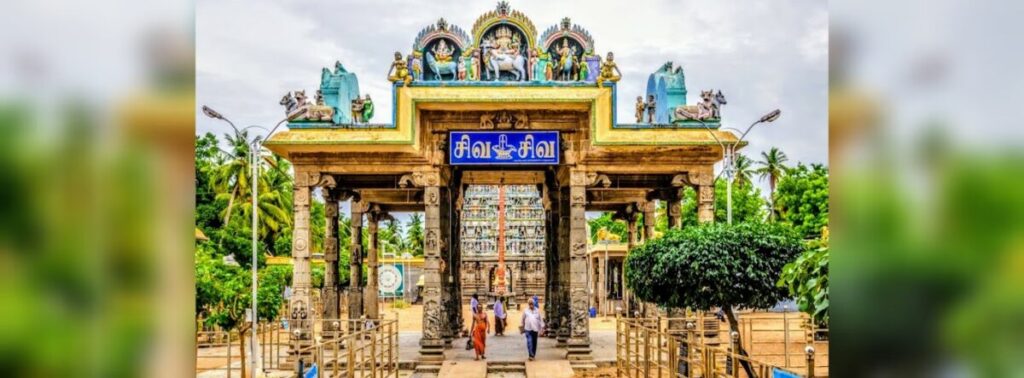
THIRU VIZHAL NAGAR (103/276)
|
Name |
Thiru Vizhal Nagar |
|
Other Names |
Thirvilanagar |
|
District |
Nagapattinam |
|
State |
Tamilnadu |
|
Devaram |
Thiru Gnana Sambandhar |
|
Position |
South of Kaveri – 103/276 |
|
Presiding deity |
Shiva |
|
God |
Ujjira Vaneshwarar Thurai Kaatum Vallal Kaveri Thurai Kaatiya Naadhar |
|
Goddess |
Vei Tholi Ammai, Veyuru Tholi Ammai, Thurai Kaatum Valli |
|
Sthala Vriksham |
Grass (Vizhal Pul) – Dineria hohenakeri |
|
Theertham |
Kaveri Mei Gnana Poigai |
|
Worshipped by |
Arulvithan |
|
Temple timings |
6AM to 12PM 6PM to 8PM (Temple is mostly closed, don’t go by the board, Call the priest in advance) |
|
Contact details |
04364-282129 |
Lore:
The presiding deity of the shrine is Ujjira Vaneshwarar
Why is the village called as Thiru Vizhal Nagar?
The locale was abundant with a luxuriant and teeming grass called Vizhal Pul and hence the village acquired the name of Thiru Vizhal Nagar which later got attenuated to Thiruvila nagar
Why is the Lord Ujjira Vaneshwarar called as Thurai Kaatum Vallal?
Once upon a time when there was a boy called Arul Viththan who used to worship The Lord of this shrine daily. He used to bring flowers from the other side of the river Kaveri for offering to Ujjiravaneshwarar. Once, The Lord decided to test the boy’s devotion and caused a flood to happen in the river as he was crossing it. The boy was struggling to hold on to the flowers in the basket that he had so lovingly collected for the Lord, instead of throwing them away and swimming to safety. The Lord then appeared and showed him the bank to climb upon and ensured his safety. Hence, He is called Thurai Kaatum Vallal.
Eons later, when Thiru Gnana Sambandhar wanted to visit this shrine, he was stopped by a raging deluge in the river Kaveri. He frantically called out for help “Yaarenum ivvidathil Thurai kaata ulleero?”. Ujjiravaneshwarar paid heed to the plea and came as a hunter and showed him the bank to cross over the river and finally Thiru Gnana Sambandhar worshipped this shrine and sang a Devara padhigam on the presiding Deity.
What does the name of the Goddess Vei Tholi Ammai mean?
The Goddess here is called as Vei Tholi Ammai or Veyuru Tholi Ammai. “Vei” means Bamboo. The Goddess is said to have slender delicate shoulders like that of a bamboo. Yet, She carries a Discus and a Conch and is poised ready to strike down the distress of Her Devotees.
Our Experience:
We became wiser as we slowly understood the remote nature of many of these temples. We were actively looking for flowers to offer to The Deities. We came across a flower-vendor and bought Arali and Saamandhi flowers for the Lord and His Lady. We were warned that goats ran amok in the shrine and that the flowers should be kept high on a pedestal else the goats would eat them before they can be offered to The Lord. Warily, we drove further to the temple premises. We were greeted by a newly renovated Raja gopuram of 5 tiers, still under the process of painting. The walls are still in ruins and perhaps will be renovated in steps.
The temple is quite big with two corridors. The temple was open, but the main shrines were closed as the priest was not there, inspite of it being 10AM. We prayed to Thurai Kaatum Vallal and Vei Tholi Ammai to bless us and kept the flowers atop the Undiyal so that the priest might take them when he comes back. By the time we worshipped the Goshta Moorthangal in the Prahaaram and came back, four goats had craftily climbed on top of the Undiyal and had dragged down the Saamandhi garland and were busy munching it. They dint touch the Arali flowers because they might have found the xerophyte flowers to be distasteful.
In the Prahaaram, there is a small flowerbed besides the eight-armed Durga Shrine which has the Vizhal Pul, the Sthala Vriksham of this shrine.
We had a peaceful darisanam and were on our way to an another amazing Paadal Petra Sthalam which was the highlight of our pilgrimage, one of the Atta Veerataanangal, Thiru Pariyalur (104/276). We are so excited, folks. See you there
Loads of love,
Karthick and Rahul