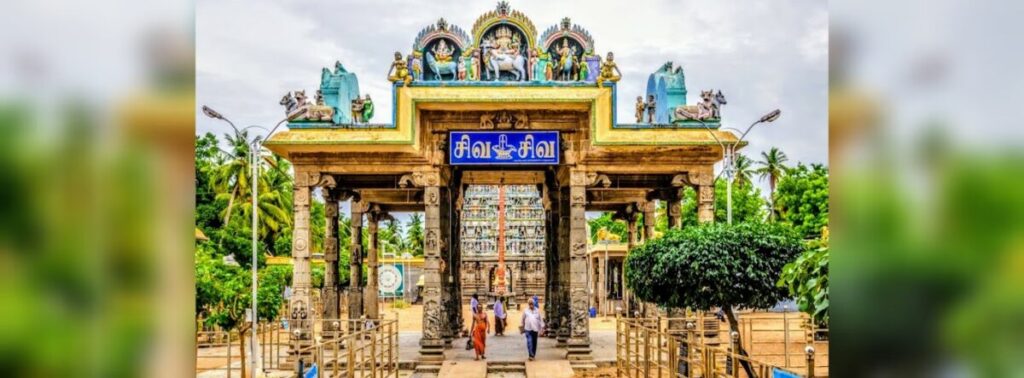
THIRININDRIYUR (19/276)
|
Name
|
Thirinindriyur
|
|
Other Names
|
Thiru Nindriyur
|
|
District
|
Nagapattinam
|
|
State
|
Tamilnadu
|
|
Devaram
|
One of the 44 Moovar Paadal petra Sthalangal
|
|
Position
|
North of Kaveri – 19/276
|
|
Presiding deity
|
Shiva
|
|
God
|
Mahalakshmiswarar
Lakshmipureeswarar
|
|
Goddess
|
Ulaga Nayagi
|
|
Speciality
|
Anusham Star parihara sthalam
|
|
Sthala Vriksham
|
Wood Apple (Vilvam)
|
|
Theertham
|
Neela Malar Poigai
Mahalakshmi Theertham
Parashurama Theertham
|
|
Worshipped by
|
Mahalakshmi, Jamadagni, Parashuram, Indra Dev and his pachyderm Airavatham, Sage Agathiyar and the Chozha king who discovered The Deity
|
|
Special Prayer
|
Sandal paste with Pomegranate seeds Alangaram to Mahalaksmiswarar
Pithru Poojai Pariharam
Akshya thrithiyai Poojai
|
|
Temple timings
|
6AM to 12PM
5PM to 8PM
|
|
Contact details
|
9846141430
|
Lore:
The presiding deity of the shrine is Mahalakshmiswarar who was worshipped by Devi Mahalakshmi. The village also goes by the name Thiru Nindriyur as Mahalakshmi resides here. (Thiru = Goddess of Wealth, Mahalakshmi)
Why is the village called as Thirinindriyur?
Legend has it that a Chozha king used to go to the Chidambaram temple through this village. Whenever the king and his entourage used to cross this place, the lamps that were carried by his retinue went off. The king was surprised by this astonishing act. He wanted to know the reason as to why the lamps went off whenever he crossed this village.
Then a cowherd who was grazing nearby (it was actually our dear Aadalvallaan in disguise) asked the king what was troubling his mind. The king dutifully told his woe to the cowherd. He then told the king that there was a Shivalingam worshipped by Mahalakshmi in this village and that one of his cows was pouring milk on The Lingam and that could be the reason as to why the lamps were going off.
The king set out to find this miraculous lingam and was enthralled when he saw Mahalakshmiswarar. He decided to uproot the Lingam and take Him to Chidambaram with him. Hence, he asked his men to unearth The Lingam. Surprisingly, the moment the spears hit the earth, it fell on The Lingam and there was a torrential bout of bleeding. The king realised that Mahalakshmiswarar wanted to stay in Lakshmipuri. He atoned for his mistake and built a temple in the same spot. As the wicks (Thiri) of the lamps stopped burning at this village, it got the name Thirinindriyur.
What is the connection between Jamadagni Rishi, Lord Parashuram and this shrine?
Parashuram was the sixth Avatar of Mahavishnu. He was one of the five sons of Jamadagni rishi (one of the saptha rishis) and Renuka Devi. Renuka Devi was so piously devout to her husband that her pativrata dharmam manifested tremendous powers. She could hold the soil of the riverbank with her palms, shape it up into a vessel and carry water in it to her hermitage for domestic usage and for her husband’s austerities.
One day, Renuka Devi went to the river and was as usual planning to make a vessel out of the river sand. While she was in the river waters, she saw the reflection of a handsome Gandharva Purushan, who was flying on a chariot in the sky. Enchanted by his beauty and charm, she lost her composure for a moment. She quickly realised her folly and went on to make the vessel from the river soil. Regrettably, the sands dint hold together. Her prowess failed to help her as her heart flinched momentarily from her devotion to her husband. She feared facing Jamadagni Rishi and dint return to the hermitage.
Meanwhile at the hermitage, Jamadagni realised what happened using his divine sight and was enraged. He sought his elder sons (Vaasu, ViswaVaasu, Brihu-Dhyanu and Bhritwa-kanwa) and instructed them to carry out his orders and behead Renuka Devi for her lack of restraint and immodesty. Being fond of their mother, the sons refused. Jamadagni got infuriated at their refusal and cursed them all to become stones, for their indignant denial and disrespect towards their father.
He then went to Ram, his youngest son and ordered him to behead Renuka Devi (He was just Ram back then, also called as Bargawa Ram or scion of the Brighu clan to differentiate Him from Ram of the Raghu Vamsam. The Parashu or Axe was acquired much later and it was then that He was glorified with the epithet as Parashu Ram). Parashuram obeyed without a moment of hesitation and immediately went to the riverbank and beheaded Renuka Devi and returns to the hermitage.
Jamadagni was pleased with this act of blind and loyal devotion of Parashuram and granted him two boons. Parashuram used those two boons and asked Jamadagni to revive Renuka Devi and restore life to the stones that were previously his elder brothers. Jamadagni did as requested by his son and there was peace (a very brief period of apparent tranquillity) at the hermitage.
Parashuram and Jamadagni then came here to Thirinindriyur and installed two Lingams and worshipped them to absolve for the sin of murder and abetment of murder. The two Lingams are respectively called as Parashurameshwarar and Jamadagnishwarar. They are in the outer Praharam along with Mahavishnu and Mahalakshmi.
Parashuram also gave 360 units of land to the temple and assigned 300 andhanargal to do Nithya pooja in the temple, using the income from one unit of land per day.
Karma had a different twist for this boy who lived a peaceful existence in a forest hermitage. From this seemingly peaceful and happy family, Parashuram was ripped apart and morphed into the vengeful Avatar of slaughter and carnage, which had the most violent and gory bloodshed, in the history of all time. (Parashurama Charitram will be discussed in its entirety in the subsequent posts)
What are the other historical details of this temple?
The Devara Padhigams describe this temple as a Maada Koil built by Kochengannan, a Chozha king. Kochengannan built around 70 Maada Koils, which are a specific style of architecture where the sanctum sanctorum is placed at a higher elevation from the ground, requiring steps to climb and access it and had narrow doorways, effectively prohibiting elephants from entering the temple. Kochengannan was said to have been a spider in his previous birth and had an innate hatred for elephants because of the fight that happened between the arachnoid form of the king and an elephant over the worship of another famous Shiva Lingam, Jambukeshwarar. But more about that in another post, where we shall see another Paadal petra Sthalam, the legendary Thiruvaanaikovil (60/276)
The Maada koil is said to have fallen to disarray because of natural calamities and/or lack of maintenance. The fallen temple was renovated 100 years ago by the Nagarathaar to its present stature.
In the Navagraha shrine, Surya dev and Chandra Dev are seen facing each other and hence the temple is auspicious for doing pooja for ancestors as it’s a Pithru pooja sthalam.
There are three temple tanks which adorn the temple complex in the form of a necklace viz, Neela Malar Poigai, Mahalakshmi theertham and Parashurama Theertham.
Our Experience:
We came directly to the shrine from Kurumaanakudi (17/276) and were greeted by a big puddle of rain in front of the Raja gopuram. We waded our way inside to see a massive temple complex. The temple is in ruins with creepers growing from all the crevices of the raja gopuram and even the walls of the shrine have started to fall apart in certain places.
The priest was there and gave us a brief introduction to the temple. The sanctum sanctorum has Mahalakshmiswarar, gracing upon us in all His glory. There is a dent in the Moola Moorthy, which is reminiscent of the Chozha king’s feeble attempt to uproot The Lingam. Ulaga Nayagi Ambal is to the left of Mahalakshmiswarar.
Then we come out to the huge open Prahaaram and pray to all the goshta moorthangal. Jamadagnishwarar, Parashurameshwarar and Mahalakshmi Devi’s Moorthy are of special importance at this shrine. Mahalakshmiswarar, The Lord who blessed Mahalakshmi, Jamadagni, Parashuram, Indra Dev and his pachyderm Airavatham, Sage Agathiyar and the Chozha king who discovered The Deity, blessed this meandering duo too.
We had a hearty darisanam and quickly started to the next Paadal petra sthalam on our list, Thiru Vizhar Nagar (103/276). See you there, folks.
Loads of love,
Karthick and Rahul