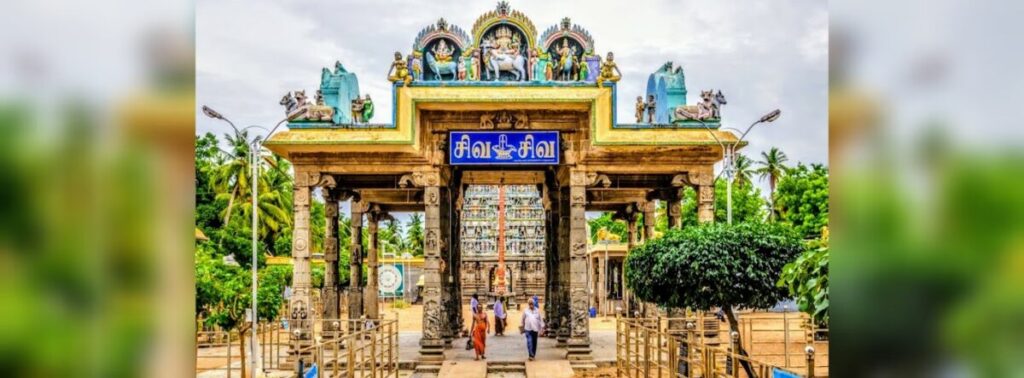
Thiru Mani Maada Kovil (32/108)
|
Name |
Thiru Mani Maada Kovil |
|
District |
Nagapattinam |
|
State |
Tamil Nadu |
|
Mangalasasanam |
Thirumangai Azhwar |
|
Position |
Chozha Naadu (32/108) |
|
Presiding deity |
Vishnu |
|
God |
Badri Narayana Perumal Vadhari Narayana Perumal Nandhaa Vilakku Perumal |
|
Utsavar |
Narayana Perumal Alatharku Ariyaan |
|
Goddess |
Pundareeka Valli |
|
Vimanam |
Pranava Vimaanam |
|
Speciality |
The oldest of the 11 Thiru Nangur Divya Desangal The shrine where the famed Eleven Garuda Sevai takes place annually during Thai Amavaasai Thirukottiyur Nambi, the guru of Ramanujar, obtained the “Thirumandhira Upadesam” from The Lord at this shrine |
|
Theertham |
Rudra Pushkarani Indra Pushkarani |
|
Worshipped by |
The Rudran of The Thathpurusha Peedam (the first Rudran) Indra Dev |
|
Temple timings |
8AM to 11PM and 5PM to 7PM |
|
Contact details |
LORE:
Why does the Sthalam go by the name of “Thiru Mani Maada Kovil”?
The shrine is built in the Dravidian style called as “Maada Kovil”. A “Maada koil” is the form of architecture where the sanctum-sanctorum is at a higher level, accessible only by a single or multiple flight of stairs and a narrow gateway. The “Maadam” is presumed to have been adorned by trinkets and precious stones and lamps lit all the way along its walls and hence the shrine is called as “Mani Maada Kovil”
The Lord of this shrine is called as “Nandhaa Vilakku Perumal” – He who shines like an eternally lit lamp.
It is said that The Badri Narayana Perumal from Thiru Vadhari Aasramam @ Badrinath (100/108) is said to have come to this shrine and is seated here.
His fame and prowess are so big that it is immeasurable by any scale. Hence, He is also called as “Alatharku Ariyaan” – The one who can never be measured.
What is the lore of the temple?
The temple shares the common lore of all the 11 Thiru Nangur Shrines and Lord Badri Narayana Perumal is said to have manifested to quell the anger of one of the Ekadasha Rudras, who emanated from the locks of the grief-stricken Lord Shiva, who danced the Pralaya Thandavam upon knowing the untimely demise of his then wife, Devi Sati.
Lord Badri Narayana Perumal is pacifying the first Rudra viz. the Rudra of the “Thathpurusha Peedam” – who resides in a temple at Thiru Nangur, presided by Lord Mathangeshwarar and His Devi, Raja Mathangi.
The details of the story are elaborated “here”
How did the Lord Badri Narayana Perumal come to this shrine?
The Lord Badri Narayana Perumal decided to pacify the anger of the 11 Rudras. He came from Thiru Vadhari Aasramam @ Badrinath (100/108) in a chariot, with Lord Brahma as the charioteer and the four Vedhas as horses.
The temple and the Vimaanam are built in the form of a chariot. The Kalasangal of the Vimanam are pointing towards the Raja Gopuram.
What was Garuda’s yearning and how did it get fulfilled?
While Badri Narayana Perumal came to Thiru Nangur, he did not fly on his Garuda Vahana, as The Lord usually does, but he chose to commute via a chariot.
This is why Garudan who is usually facing the feet of The Lord is not housed proximal to him on the second floor of the Maadam, but stays in a separate shrine close to the Kodi Maram, ass though waiting for an opportunity to carry the Lord at his behest.
The Lord conceded Garuda’s request and annually He and all the other 10 Lords of the Thiru Nangur Divya Desangal come to Thiru Mani Maada Kovil and ascend on the 11 Garuda Vahana and give us Darisanam, along with Thirumangai Alwar on Hamsa Vahanam and Manavaala Maa Munigal on Sesha Peedam.
What does the word “Badri” mean?
“Badri” means “Jujube berry”. It is called as “Vadhari” in Tamizh. Vernacularly, it is called as “Elandhai Maram”
The Lord appeared as Narayana Perumal and preached the “Thirumandhiram” to Nara under the Badri tree. Hence the shrine and the Lord derive their name from the tree.
Who are Nara and Narayana?
The Lord had taken two incantations as Nara and Narayana for the welfare of the world and to establish Dharma. They are deities who are described as meditating sages. The word “Nara” means “Human”, whereas “Narayana” literally means “One who is resting on water”, and in this context, it denotes The Lord Vishnu, who is reclined on Adhi Seshan in Thiru Paarkadal (107/108).
The Lord manifested as the teacher in Narayana and as the disciple in Nara. The symbology is that “He taught Himself”. He meditated on Himself. As Narayana, He revealed the “Ashtakshara Mandhiram” – Om Namo Narayanaya, to Nara, and we all are getting benefitted by His teaching.
A few anecdotes about Nara And Narayana:
- Arjuna and Krishna are said to be the re-incarnation of Nara and Narayana, respectively.
- Nara and Narayana were instrumental in the destruction of a demon known as “Sahasra Kavacha Asura” – the one with 1000 armours.
- The celestial damsel, Urvashi, is said to have been born form the thigh (Uru – Thigh) of Narayana.
- Nara and Narayana are said to be the sons of Dharma, the son of Lord Brahma and his wife Murti, the daughter of Daksha Prajapati.
- Even the mighty Paashupathasthra of Lord Shiva was rendered powerless, in front of their benevolent yogic powers.
- They are believed to be in a state of “Nirvikalpa Samadhi” and meditating at Thiru Vadhari Aasramam @ Badrinath (100/108).
How was Indra Dev blessed at this shrine?
Eons ago, due to the insolence of Indra Dev, he had incurred the wrath of Rishi Durvasa as he had insulted the offering given by the sage, who is known for his labile temperament. In his arrogance, he had unwittingly given the garland which had adorned Adhi Shakthi herself to his pachyderm, Airavatham. The foolhardy elephant, not realizing the sanctity of the garland, threw it on the ground and stomped it. As if waiting for something untoward like this to happen, Rishi Durvasa, cursed the entire cosmos for Indra Dev’s misdemeanour, that the whole world will be bereft of wealth and prosperity. The Devas thus became Shree Heen (impoverished) and Shakthi Heen (flaccid). Indra Dev soon realized his folly and pleaded for redemption. The Rishi told that the curse would be undone when Goddess Lakshmi is evoked from the abyss of Ksheer Sagar (the great white ocean – Thirupaarkadal).
Thus, began the daunting task of the Samudra Mandhan, the churning of the great milky white ocean. Mandhara Parvatham was asked to be the pestle. The king of serpents, Lord Shiva’s Shankarabaranam, Vasuki was deigned to be the rope to churn the pestle. The Devas took the tail end of the snake. The Asuras were also asked to take part in the Samudra Mandhan with the promise of a share in the wealth that was buried under the great ocean. The Asuras took over the head end of the snake.
The churning began and slowly the hidden treasures of the great white ocean manifested amidst the Devas and Asuras. Sequentially, the wealth of the ocean was shared between the two factions. The pestle got destabilized by the incessant churning and started to sink into the ocean. Lord Vishnu took the form of a giant turtle and lifted the sinking mountain on his back, to ensure that the churning continues uninterrupted.
The moon emerges from the ocean and joins the faction of the Devas as Chandra Dev. Then arrives Chandra Sahodhari, The Goddess of wealth and prosperity, Devi Lakshmi. She chooses the preserver of the cosmos, Lord Vishnu as Her consort.
At the end, Lord Dhanvanthri emerges with a pot of Ambrosia, marking the end of the Samudra Mandhan.
Indra Dev, who was solely responsible for creating so much grief upon the world, got absolved of his sin of disrespecting the Rishi, by bathing in the temple tank (Indra Theertham) and praying to Lord Badri Narayana Perumal, at this shrine.
What are the other specialities of the shrine?
- Largest and first of the 11 Thiru Nangur Divya Desangal
- This is the shrine where the Eleven Garuda Sevai Utsavam takes place annually
- There is no Thirumanjanam for the main deity, only Thaila Kaapu is offered.
- He is seated in “Lalithasana”, the pose of “Royal Ease”, with the left leg folded and the right leg pendent upon a lotus in full-bloom.
- The rays of the sun fall on The Lord, in the morning hours, all round the year.
- The Utsava Moorthy hold the “Prayoga Chakram”
- Pundareeka Valli is housed in a separate shrine as “Thani Kovil Naatchiyaar”
- There is a separate shrine for Thirukottiyur Nambi, the guru of Ramanuja
- The Lord Badri Narayana Perumal is facing Lord Matangeshwarar, in the temple almost directly opposite to Thiru Mani Maada Kovil.
- This is the shrine where Thirukottiyur Nambi, the guru of Ramanuja obtained the “Thirumandhira Upadesam” from The Lord Badri Narayan Perumal.
Our Experience:
We had visited this shrine thrice, and we were able to see The Lord Badri Narayan Perumal, all the three times.
The first time we saw Him was on an exploratory visit to Thiru Nangur. We did not even realise that this was a separate temple and we mistook it for Thiru Manikoodam (37/108). It was nightfall and we took a wrong turn, which had led us to Thiru Mani Maada Kovil (32/108). We had already been to Thiru Manikoodam during the day time and we wanted to try our luck there as it was nearing the closing time.
We entered the Thiru Mani Maada Kovil temple and it is almost 5 times bigger than Thiru Manikoodam. Brushing our suspicions aside, we rushed towards the sanctum sanctorum. Only on beginning to climb the two flights of stairs, we realised that this is a separate Divya Desam, one we had neither read about nor were aware of. It was as though The Lord, Himself had summoned us there.
It was here, that we came to know about the “Eleven Garuda Sevai Festival”, which was put up on a humble flex banner in the temple premises and we had made up our minds to attend the Utsavam, at all costs. We had marked the dates and were really curious as to how the Lord’s of the 11 Diya Desangal would reach the temple and on what scale would the festival itself be.
The second time was during the actual Eleven Garuda Sevai Utsavam, one which will always remain close to our hearts. The temple is open throughout the day, as this is the shrine where the actual festival takes place. We can see Lord Badri Narayana Perumal, all day long.
It is obvious as to why this temple is chosen for the festival. Primary reason is that this is the first of the Eleven Thiru Nangur Divya Desangal, where Lord Vishnu had appeared as Lord Badri Narayana Perumal to pacify the Ekadasha Rudras. All the other 10 forms of The Lord at the other 10 Divya Desangal appeared only after Him.
The second reason is that Thiru Mani Maada Kovil is easily the largest of all the 11 temples with a wide mandapam to house the Eleven Lords on their Garuda Vahana, Thirumangai Alwar on Hamsa Vahana and Manavala Maa Munigal on Sesha Peedam.
The Temple tank is also huge, second only to the Thiru Paarkadal Theertham of Thiru Vann Purshotthamam (30/108).
Our experience of the “Eleven Garuda Sevai Festival 2020” will be given in a separate post. Click here to read about it.
The third time was unique as we had undertaken the daunting task of completing all the 11 Thiru Nangur Divya Desangal in one evening (and we actually succeeded in visiting all of them because of the blessings of The Lord). It was also in this visit that we found out that the Star of The Lord Badri Narayana Perumal is “Chithirai” (Rahul also has the same star)
The head priest is a very kind and polite person (something which we don’t get to see that often nowadays) and showed us a lengthy aarthi of The Lord.
We started at Thiru Kaavalam Paadi (27/108) at 1748 Hrs and finally finished at Thiru Paarthan Palli (40/108) at 2028 Hrs. We also saw the painting on the temple wall which depicts the temple lore clearly and then understood the actual story of the shrine. We received the blessings of Lord Badri Narayana Perumal, lavishly seated in the royal Lalithasana and His Devi, Pundareeka Valli Naatchiyaar and left with loads of endearing memories.
See you folks at the next temple in the Thiru Nangur Divya Desangal – Thiru Devanaar Thogai (36/108)
Loads of love,
Karthick and Rahul.